

Tortilla Market Size to Reach USD 75.86 Billion by 2035 Amid Rising Preference for Organic and Gluten-Free Products
Tortilla Market
Expanding product innovation, evolving consumer dietary preferences, and wider retail availability continue to shape the global tortilla industry landscape
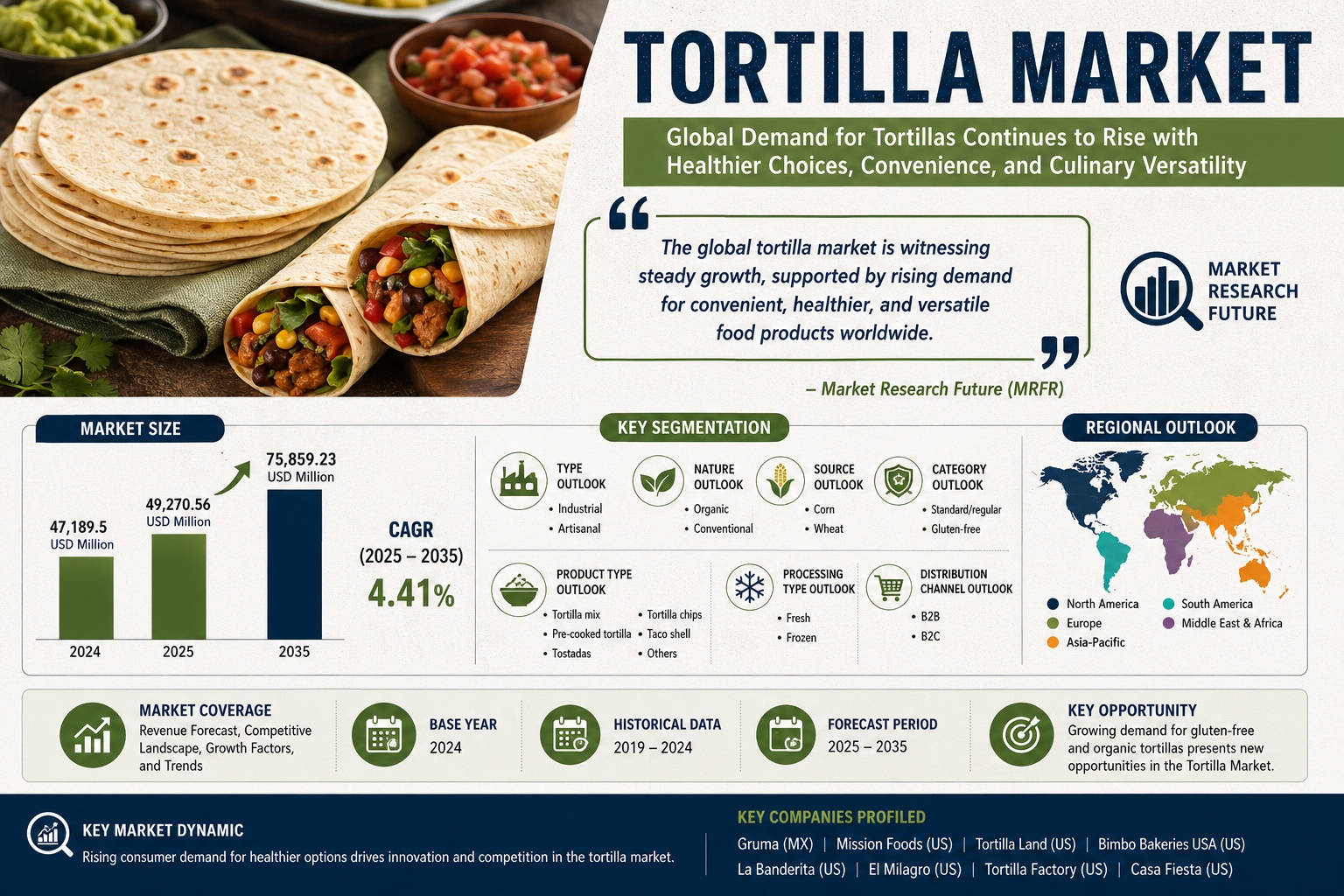
The global tortilla market is witnessing steady growth, supported by rising demand for convenient, healthier, and versatile food products worldwide.”
NEW YORK, NY, UNITED STATES, June 22, 2026 /EINPresswire.com/ -- The global Tortilla Market is witnessing sustained expansion as consumers increasingly incorporate tortillas into everyday meals due to their versatility, convenience, and compatibility with diverse dietary preferences. According to Market Research Analysis, the global tortilla market was valued at USD 47,189.5 million in 2024 and is projected to grow from USD 49,270.56 million in 2025 to USD 75,859.23 million by 2035, registering a CAGR of 4.41% during the forecast period from 2025 to 2035.— Market Research Future (MRFR)
Tortillas have evolved far beyond their traditional role in Mexican cuisine. Today, they are widely utilized in wraps, tacos, burritos, quesadillas, snacks, and ready-to-eat meal solutions across international markets. Their adaptability has enabled manufacturers to develop innovative product formats that appeal to health-conscious consumers, foodservice operators, and retail buyers alike.
Growing awareness of healthier eating habits, increasing interest in plant-based ingredients, and rising demand for gluten-free and organic alternatives are creating new opportunities across the tortilla industry. Manufacturers are actively expanding their product portfolios to meet evolving consumer expectations while maintaining taste, convenience, and affordability.
Consumer Preferences Continue to Influence Product Development
The modern food industry is experiencing a noticeable shift toward products that align with healthier lifestyles. Consumers are paying closer attention to ingredient sourcing, nutritional content, and production methods. This trend has encouraged tortilla manufacturers to introduce products made from organic grains, non-GMO ingredients, and alternative flour sources.
Health-focused consumers are increasingly seeking products with reduced additives and cleaner ingredient labels. As a result, organic tortillas are gaining popularity in both developed and emerging markets. At the same time, gluten-free formulations have become an important category, attracting consumers with dietary restrictions as well as those pursuing wellness-oriented eating habits.
Manufacturers are responding by investing in research and development activities aimed at improving product texture, flavor, shelf life, and nutritional profiles. Enhanced formulations are helping companies differentiate themselves within an increasingly competitive marketplace.
Market Overview
The tortilla market has transformed into a significant segment of the global bakery and convenience food industry. Product accessibility through supermarkets, hypermarkets, convenience stores, specialty retailers, and online platforms has contributed to broader consumer adoption.
Urbanization, busy lifestyles, and increasing demand for convenient meal solutions have further strengthened market penetration. Tortillas serve as versatile meal components that can be incorporated into breakfast, lunch, dinner, and snack applications, making them attractive to consumers seeking quick yet customizable food options.
Additionally, foodservice establishments including restaurants, quick-service chains, cafés, and catering providers continue to utilize tortillas in a wide variety of menu offerings. This sustained demand from commercial buyers supports overall market expansion and encourages ongoing innovation throughout the supply chain.
Organic Tortillas Gain Momentum
The organic segment has emerged as one of the most dynamic areas within the tortilla market. Consumers increasingly prefer food products produced without synthetic pesticides, chemical fertilizers, or genetically modified ingredients.
Organic tortillas appeal to health-conscious shoppers who prioritize transparency and sustainability. Retailers are expanding shelf space dedicated to organic food products, enabling greater visibility and accessibility for organic tortilla offerings.
Manufacturers are also leveraging organic certifications as a competitive advantage, helping strengthen brand credibility and consumer trust. As awareness surrounding sustainable agriculture continues to grow, demand for organic tortillas is expected to remain strong throughout the forecast period.
Gluten-Free Products Create New Opportunities
The growing popularity of gluten-free diets has encouraged significant innovation within the tortilla industry. Corn-based tortillas naturally align with gluten-free dietary requirements, making them particularly attractive to consumers managing gluten sensitivities or seeking alternative grain options.
Manufacturers are introducing a broader range of gluten-free tortillas featuring ingredients such as cassava flour, almond flour, chickpea flour, and other specialty formulations. These innovations are expanding consumer choice while supporting category growth.
In addition to individuals with dietary restrictions, many consumers perceive gluten-free products as part of a healthier lifestyle, further supporting demand across multiple demographics.
Get Full PDF Sample Copy of Report: (Including Full TOC, List of Tables & Figures, Chart) @ https://www.marketresearchfuture.com/sample_request/2419
Corn and Wheat Remain Core Sources
Based on source, the tortilla market is segmented into corn and wheat tortillas.
Corn tortillas continue to represent a foundational category due to their cultural significance, authentic flavor profile, and naturally gluten-free characteristics. They remain particularly popular in North America and Latin American markets, where traditional culinary applications maintain strong consumer demand. Corn-based tortillas account for a substantial share of global consumption, supported by increasing demand for gluten-free products and growing consumer awareness of traditional whole-grain ingredients. The segment is also benefiting from innovations in fortified corn tortillas that incorporate additional fiber, protein, vitamins, and minerals to enhance nutritional value.
Wheat tortillas, meanwhile, have achieved widespread popularity due to their soft texture and versatility. They are extensively used in wraps, burritos, sandwiches, and fusion cuisine applications. Their adaptability across diverse meal occasions has helped strengthen their position in both retail and foodservice channels. Wheat tortillas continue to experience strong demand in urban markets where convenience foods and ready-to-eat meal solutions are gaining traction. Manufacturers are increasingly introducing whole-wheat, multigrain, and high-protein variants to appeal to health-conscious consumers seeking improved nutritional profiles.
Manufacturers continue exploring hybrid formulations and specialty grain combinations to address changing consumer preferences while maintaining familiar taste and texture attributes. Emerging products incorporating ingredients such as quinoa, flaxseed, chia, cassava, chickpea flour, and ancient grains are gaining attention among consumers looking for functional and premium food options. These innovations are helping companies expand their customer base while creating new revenue opportunities across both developed and emerging markets.
Product Innovation Drives Competitive Differentiation
Innovation remains a critical success factor within the tortilla industry. Companies are introducing a wide range of products tailored to specific consumer needs and usage occasions. Product development efforts are increasingly focused on clean-label formulations, reduced-sodium recipes, organic ingredients, plant-based offerings, and enhanced nutritional content. These initiatives are helping manufacturers respond to evolving dietary trends while strengthening brand differentiation.
Market segmentation by product type includes:
• Tortilla Mix
• Pre-Cooked Tortilla
• Tostadas
• Tortilla Chips
• Taco Shell
• Other Specialty Products
Among these categories, tortilla chips represent one of the fastest-growing segments due to rising global demand for savory snacks. The segment has benefited from premiumization trends, with manufacturers introducing baked, low-fat, organic, and flavored varieties to attract a broader consumer audience. Increasing consumption during social gatherings, entertainment occasions, and on-the-go snacking has further supported category growth.
Tortilla chips have become particularly popular within the snack category, benefiting from growing consumer interest in convenient and shareable food options. Manufacturers are introducing new flavors, seasoning blends, and premium ingredient combinations to enhance product appeal. Popular flavor innovations include spicy chili, lime, barbecue, cheese, jalapeño, and globally inspired seasoning profiles designed to appeal to regional tastes.
Similarly, taco shells and tostadas continue to experience demand as consumers increasingly recreate restaurant-style dining experiences at home. Ready-to-use formats provide convenience while supporting culinary experimentation. Growth in meal-kit services and home cooking trends has further contributed to demand for these products, particularly among younger consumers seeking quick and customizable meal solutions.
Pre-cooked tortillas and tortilla mixes also appeal to consumers seeking preparation flexibility and time-saving meal solutions. Foodservice operators, institutional kitchens, and commercial bakeries increasingly utilize these products to improve operational efficiency while maintaining product consistency. Advances in packaging technology and shelf-life extension methods are also supporting wider distribution and reducing product waste throughout the supply chain.
Overall, continuous product innovation remains essential for market participants seeking to capture emerging consumer trends, expand into new geographic markets, and strengthen long-term competitive positioning within the global tortilla industry.
Fresh and Frozen Processing Segments Expand Reach
The market is segmented by processing type into fresh and frozen tortillas.
Fresh tortillas remain highly desirable due to their authentic taste, texture, and perceived quality. Many consumers associate freshly prepared tortillas with superior flavor and culinary authenticity.
Frozen tortillas, however, provide significant advantages in terms of storage, transportation, and shelf life. Their convenience has made them increasingly attractive for foodservice operators, institutional buyers, and retailers seeking inventory management efficiencies.
Advancements in freezing technologies and packaging solutions have improved product quality, helping frozen tortillas maintain texture and flavor characteristics that closely resemble fresh alternatives.
Industrial Production Supports Large-Scale Growth
By type, the tortilla market is categorized into industrial and artisanal production.
Industrial manufacturers continue to dominate global volume production due to their ability to achieve economies of scale, maintain consistent quality standards, and support extensive distribution networks.
At the same time, artisanal tortillas are attracting consumers interested in traditional preparation methods, premium ingredients, and authentic culinary experiences. Local producers and specialty brands are leveraging craftsmanship and heritage positioning to differentiate themselves from larger competitors.
The coexistence of industrial efficiency and artisanal authenticity creates a diverse market landscape that accommodates varying consumer preferences.
B2B and B2C Channels Support Market Accessibility
Distribution channels play a critical role in connecting tortilla manufacturers with end users.
The B2C segment includes supermarkets, hypermarkets, convenience stores, specialty food retailers, and online platforms. Retail expansion and digital commerce adoption have significantly improved product accessibility.
Meanwhile, B2B channels encompass restaurants, foodservice providers, hospitality operators, institutional buyers, and food manufacturers. Commercial demand remains an important growth contributor as tortillas continue to serve as foundational ingredients across numerous menu applications.
E-commerce platforms are also creating new opportunities by enabling direct-to-consumer engagement and broader geographic reach.
Regional Analysis
North America
North America remains the largest regional market for tortillas, accounting for a significant share of global revenue in 2024. Strong consumer familiarity, widespread retail availability, and growing multicultural food preferences continue to support market leadership. The region benefits from a well-established foodservice sector, extensive supermarket penetration, and strong demand for convenient meal solutions.
The United States represents a particularly significant market due to the popularity of Mexican-inspired cuisine, convenient meal solutions, and healthier snack alternatives. Rising demand for organic, low-carb, whole-grain, and gluten-free tortilla products is encouraging manufacturers to expand their product portfolios. Canada is also witnessing steady growth, supported by increasing ethnic food consumption and growing interest in ready-to-eat and on-the-go meal options.
Europe
European markets are experiencing increasing adoption of tortillas as consumers embrace international cuisines and convenient meal preparation options. Growing awareness of gluten-free and organic products is further supporting market development. Countries such as the United Kingdom, Germany, France, Spain, and Italy are seeing rising demand for wraps, burritos, tacos, and other tortilla-based foods across both retail and foodservice channels.
The expansion of quick-service restaurants and the growing popularity of Mexican and Tex-Mex cuisine are contributing to market growth. Additionally, consumers are increasingly seeking healthier alternatives to traditional bread products, creating opportunities for whole-wheat, high-fiber, and plant-based tortilla offerings.
Asia-Pacific
The Asia-Pacific region presents substantial opportunities due to urbanization, rising disposable incomes, and expanding exposure to Western and international food trends. Increasing foodservice activity and retail modernization contribute to broader market penetration. The region is expected to register one of the fastest growth rates during the forecast period as consumers increasingly adopt convenient and versatile food products.
Countries including China, India, Japan, South Korea, and Australia are witnessing growing demand for tortillas through supermarkets, hypermarkets, and online retail platforms. The expansion of international restaurant chains and the popularity of fusion cuisine are further supporting market growth. Manufacturers are also introducing localized flavors and product variations to cater to regional consumer preferences.
South America
South America benefits from cultural familiarity with corn-based products and ongoing expansion of packaged food categories. Local production capabilities and consumer acceptance continue to support regional demand. Countries such as Brazil, Argentina, Chile, and Colombia are experiencing increased consumption of tortilla products through both household and commercial channels.
Growing urban populations, rising disposable incomes, and expanding retail infrastructure are contributing to market development. Demand for affordable and convenient meal solutions is encouraging manufacturers to strengthen distribution networks and introduce innovative product formats tailored to local tastes.
Middle East and Africa
The Middle East and Africa region is gradually adopting tortilla products through expanding retail infrastructure, tourism activity, and growing interest in international cuisine offerings. The increasing presence of global restaurant chains and foodservice operators is helping introduce tortilla-based menu items to a broader consumer base.
Countries including the United Arab Emirates, Saudi Arabia, South Africa, and Egypt are emerging as important markets due to rising urbanization and changing dietary habits. Growth in modern retail channels, coupled with increasing demand for convenient packaged foods, is expected to support steady market expansion across the region throughout the forecast period.
Competitive Landscape
The global tortilla market features a combination of multinational manufacturers, regional brands, and specialty producers competing through innovation, product quality, and distribution reach.
Key companies profiled in the market include:
• Gruma (Mexico)
• Mission Foods (United States)
• Tortilla Land (United States)
• Bimbo Bakeries USA (United States)
• La Banderita (United States)
• El Milagro (United States)
• Tortilla Factory (United States)
• Casa Fiesta (United States)
Industry participants continue investing in production capacity expansion, product diversification, packaging innovation, and strategic partnerships to strengthen market positioning.
Companies are increasingly focused on addressing consumer preferences for clean-label products, organic ingredients, gluten-free alternatives, and sustainable sourcing practices.
Future Outlook
The global tortilla market is expected to maintain positive momentum through 2035 as consumer lifestyles continue evolving and demand for convenient, versatile food products remains strong.
Opportunities are expected to emerge from expanding organic product adoption, increasing gluten-free consumption, innovative flavor development, premium product positioning, and broader international market penetration.
Manufacturers that successfully combine nutritional value, convenience, authenticity, and affordability are likely to strengthen their competitive standing in the years ahead.
As consumers continue seeking flexible meal solutions that accommodate diverse dietary preferences, tortillas are expected to remain an integral component of modern food consumption patterns worldwide.
Discover Related Research Reports By Market Research Future:
Frozen Foods Market
https://www.marketresearchfuture.com/reports/frozen-foods-market-7585
Tortilla Chips Market
https://www.marketresearchfuture.com/reports/tortilla-chips-market-21808
Gluten-Free Tortilla Market
https://www.marketresearchfuture.com/reports/gluten-free-tortilla-market-35457
Sagar Kadam
Market Research Future
+1 628-258-0071
email us here
Visit us on social media:
LinkedIn
Facebook
X
Legal Disclaimer:
EIN Presswire provides this news content "as is" without warranty of any kind. We do not accept any responsibility or liability for the accuracy, content, images, videos, licenses, completeness, legality, or reliability of the information contained in this article. If you have any complaints or copyright issues related to this article, kindly contact the author above.
